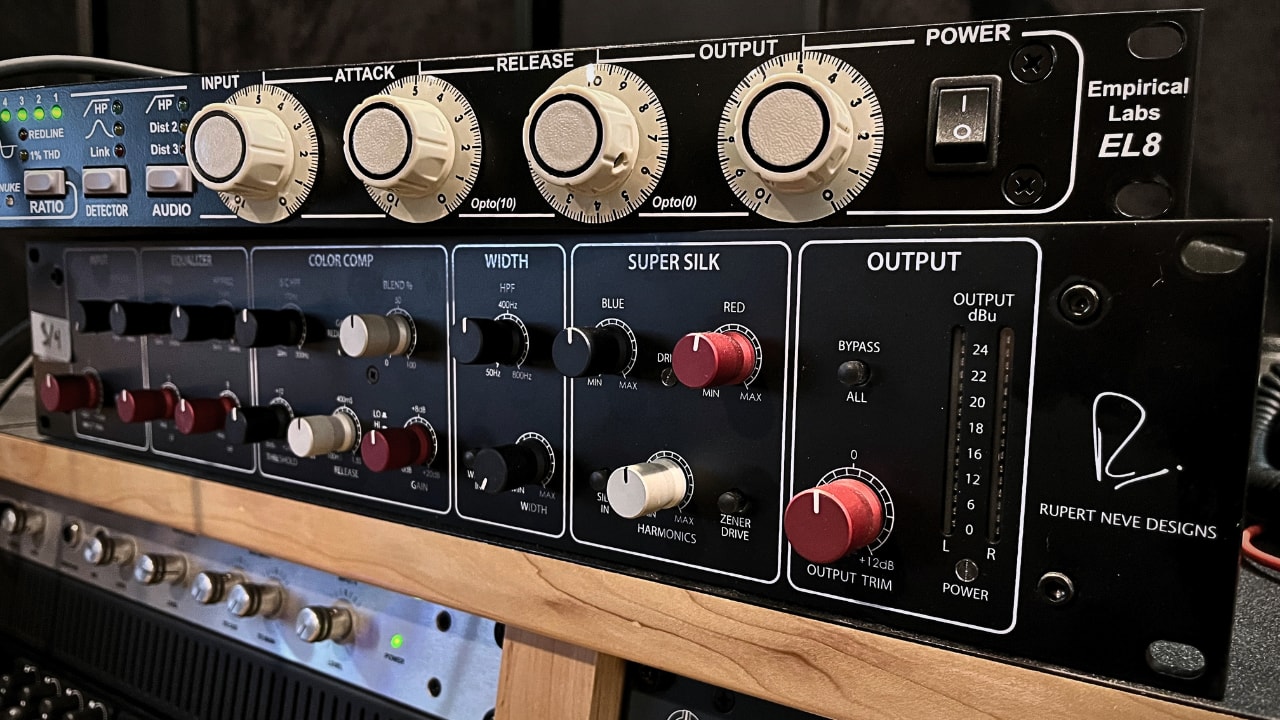
We’re huge fans of hardware modeling. Some of the most impressive work in our whole field comes from companies who set out to recreate a classic piece of gear and absolutely nail it. Universal Audio, Solid State Logic modeling their own consoles, Empirical Labs putting the Distressor in a plugin, Kazrog capturing the transformers inside legendary preamps. These are the plugins we open every day, and a lot of them end up in our own work. The accuracy is genuinely a marvel, and we have nothing but respect for the people chasing it.
Our own interest sits in a slightly different spot. We love modeling hardware too, but for us it tends to be the starting point rather than the destination.
We’re less focused on recreating a unit down to the last detail, and more interested in capturing the character that makes it special, then seeing what we can build from there.
What hardware modeling actually involves
Most people picture modeling as test tones. You send sine sweeps through a unit, measure what comes back, and build a profile from the numbers. That part is real, and it matters. On its own, though, it tends to give you something accurate and a little flat.
The other half is running real music through the hardware. Not sweeps, but DI guitars, drums, distorted guitars, vocals, bass, and full mixes. You send actual program material into a unit and listen to how it reacts, because hardware doesn’t behave the same way with a sine wave as it does with a snare hit or a wall of guitars. You also capture it across its whole range rather than at a single setting. Every knob position behaves a little differently, so you map the behavior of each control instead of taking one snapshot and calling it done. Then you bring all of it together into something that moves and responds the way the original does.
That difference is the whole point. A unit’s character doesn’t live in its frequency response alone. It lives in how it reacts to a real performance, in the harmonics it adds when you push it, in the way it grabs a transient. You only really catch that by feeding it the kind of audio it was built to shape.
Character as a starting point
Here’s how we think about it. The companies making flawless clones have that covered, and they do it beautifully. What excites us is taking the character we capture and using it as raw material.
The hardware becomes a source of inspiration, a set of ingredients we can pull from, rather than a finish line.
So far we’ve modeled a handful of units we love, along with a couple of amps, and the captures sound genuinely exciting to us. The part we look forward to most is the question that comes after the capture, which is where this character belongs and what it could become. That’s the creative part, and it’s the reason we got into this in the first place.